The Cord Cutting Fantasy Isn’t Delivered With Just an Apple TV
The 4th generation Apple TV is a very nice device. It’s designed to fit seamlessly into a modern HDTV home entertainment system. But the total solution for those with a cord cutting mindset, trying to make a transition, is very complex. One needs a multitude of resources, with only one component supplied by Apple.
For starters, the cord cutter needs a roadmap. What essential services result in a given monthly bill? Plus what’s the bill for new hardware?
In terms of a roadmap, there’s nothing like a certain kind of graphic to convey information about multiple competitors. Business Insider has constructed such a chart: “This chart shows how absurdly complicated Netflix’s competitive landscape has become.” Not only does this chart size up the “competitive landscape” in streaming video but it also serves as a roadmap for those people trying to construct a cord cutter package that meets their needs.
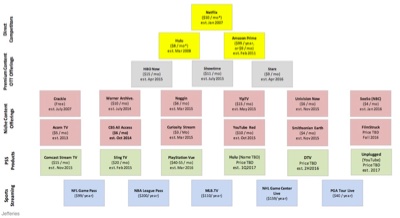
See original article for full size chart.
For example, one might select Netflix as the anchor and add, say, CBS All Access and then add a sports package. What’s cool about the chart is that the pricing is included in each box, so one can estimate total monthly charges. I liked this chart a lot for that reason, but it also got me thinking about why the rate of cord cutting remains so low.
Cord Cutting Agony
My first reaction was that it’s a very complicated process to cut the cord. If one, say, upgraded a cable DVR recently, then one has committed to a new contract that’s very expensive to break out of. Even if one can terminate the TV service after a pleasant (!) conversation with customer service, it might complicate the bundling of the ISP side if one is with, say, Comcast/Xfinity or Time Warner. And then one may have to spend some time ripping out hardware, reconfiguring, selecting a streaming box, and then selecting streaming services from the chart above.
That’s a big challenge for many families that have conflicting interests. Plus, because it’s a major undertaking, the scope and detail of a guide like this is still very limited. One almost needs an entire magazine, on paper, full of resources, scenarios, diagrams and step-by-step instructions. Complicating that is the arrival of 4K UHD TVs, HDR requirements, 4K UHD Blu-ray players and the need to upgrade, perhaps, a non-cable 4K DVR.
It’s a crazy mess, and the prospects are enough, I suspect, to cause most families to just stay with what they have, doing occasional, piecemeal replacements. One thing that can help is to find a CEDIA professional in your town who can advise and help implement.
Cord Nevers have an advantage. Starting with something simple is easy to build on. In fact, it’s probably a good idea for families with conventional systems to start all over in, say, a den, and build a prototype cord cutter system as an engineering prototype. Later, the configuration can be duplicated in other rooms.
Apple to the Rescue!?
If Apple so desired, there’s a lot more the company could do to make this process simpler and more friendly with cool, advanced hardware. For example,
- A simple 55 & 65-inch (OLED) 4K UHD TV with HDR that doesn’t phone home, betraying our privacy.
- A 4K OTA DVR (APFS on Flash/SSD) with a (thankfully) modest monthly subscription fee billed to iTunes.
- A compatible 5th generation 4K UHD Apple TV.
Everything would “Just work.” Now that would be cool.
Next page: The Tech News Debris for the Week of July 11th. iPhone stress relief.
Page 2 – The Tech News Debris for the Week of July 11th
iPhone Stress Relief
Despite the evolution of the iPhone, with its ever increasing sophistication, the replacement rate by customers is systematically stretching out. This chart from Citi analysts shows the trend. (Note however that everything beyond June, 2016 is a projection.) Why this is happening is likely based more on economics, technical maturity and stress analysis than a waning appetite for technology.

We’re always dreaming (and fretting) about the next iPhone
That is, when the carriers stopped rolling most of the the cost of a new iPhone into monthly plans, customers became more acutely aware of the actual hardware cost, even if on the basis of a low cost loan. Upshot: Freedom from subsidies also means freedom to cut costs. That’s done by stretching out the upgrade cycle. TANSTAFL.
I am reminded of one of Murphy’s laws. Under the most strictly held conditions of temperature, pressure and humidity, the organism will do as it darn well pleases.
In Apple’s case, an unintended consequence of market saturation is the fiscal psychology of the less affluent segment of the market, combined with a sense of being overwhelmed.
While on that subject… Are you feeling a bit overwhelmed these days by technology change? Here’s a neat article from the CEDIA blog. (That’s the Custom Electronic Design & Installation Association.) The explanation for these predictions is good, “The Law of Accelerating Returns,” if it makes you feel any better.
That premise, famously posited by Google Futurist Ray Kurzweil, states that information technology is growing—and learning—exponentially. Humans don’t operate that way—we are, by our nature, linear—but the machines we’ve created have the ability to double their “thinking” power at a startling rate. Exponentially, in fact.
As people, we plod along. We proceed in simple steps, one after another.
I don’t think most people really hate change. They just hate the stressful rate of change. To keep up, a lot has to be left behind. Reminds me of Apple.
Along those lines, here’s a companion article. “Science catching up with science-fiction.” IoT is notable in that regard, as is the miraculous iPhone.
Speaking of iPhones, check out: “iPhone 7 and Apple’s next Retina Display frontier: Wide Color.” Do you see the logo on the orange square?
Moving on….
We know the black hats spend their whole lives trying to hack into computer systems for profit. Wouldn’t it be cool if a team of stellar ex- MI5, MI6, GCHQ, CIA, and FBI people got together to form an organization to fight the black hats? That’s exactly what Darktrace is doing. Well funded, they are now helping to protect over 1,000 businesses. Very cool stuff.
If you’ve been wondering about PC sales over the last few years, here’s a bar chart that sums up Global PC shipments, by quarter, since 2008. “5 Years Past ‘Peak PC’.” It’s fascinating because if you had looked at this entire chart, via a time machine, back in 2010, you might have concluded that (joy!) the iPad would be the cause of the decline. Oops.
What happens if you give people a cell phone in their Apple Watch? They’d talk and talk, right? Then complain about the short battery life. Adrian Kingsley-Hughes ponders: “Why cellular on the Apple Watch 2 will be a feature you’ll hate.”
Finally, for some comic relief on a hot July Friday, I present: “2 California men fall off edge of ocean bluff while playing ‘Pokemon Go’.” (They are okay, thank goodness.)
More delicious than ice cream, I’d say.
____________________________
Particle Debris is a generally a mix of John Martellaro’s observations and opinions about a standout event or article of the week (preamble on page one) followed on page two by a discussion of articles that didn’t make the TMO headlines, the technical news debris. The column is published most every Friday except for holidays.
0 Response to "The Cord Cutting Fantasy Isn’t Delivered With Just an Apple TV"
Post a Comment