What You Need to Know About 2K Movies on iTunes Upscaled and Labelled as 4K
The demand for 4K movies has brought about the business of upscaling 2K movies to 4K and marketing them as 4K. Should we care?
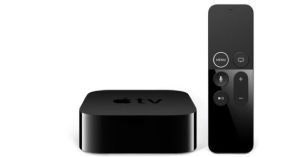
The Apple TV 4K has its own scaler. That matters,
On September 27, Joseph Keller at iMore brought up an interesting point. Some of the new iTunes movies that Apple launched in parallel with the Apple TV 4K are actually 2K movies that have been upscaled to 4K. Is this a problem? I have some thoughts.
But before we proceed, a technical note is in order as a reminder.
- True 4K is 4096 x 2160 pixels. Some movies are shot in this resolution (many in other resolutions) and then mastered as HD or UHD.
- Ultra High Definition (UHD) is 3840 x 2160. Sometimes loosely referred to also as “4K”, because, well, 3840 is almost 4096. Cough.
- High Definition (HD) is 1920 x 1080 resolution. It’s sometimes called 2K in an informal way, but is not strictly 2K in the same sense that 4K is not UHD. Used here only for brevity.
Because 4K is easy to understand, it’s often used as a shorthand for UHD. Elsewhere, I often write 4K/UHD when I mean simply UHD. Here, I’ll use 2K and 4K just for simplicity to get to the point.
The Question
And so the question is, from a strictly UHD viewpoint, is a 2K movie upscaled to 4K indistinguishable from a true 4K video? That is, assuming you’re sitting close enough to avoid the Retina effect.
For starters I’ll refer to this article at CNET. “Can 4K TVs make ‘regular’ HD content look better?” The answer, to first order, is that it’s very hard to see the difference. (CNET’s Geoffrey Morrison is a TV expert.)
Recall that if any 4K TV sees a 2K video stream. it will use its own internal scaler to scale up to 4K. The next question is, does the scaler used by the studio to remaster the original 2K movie do a better job than your TV’s scaler? Again, the answer is, yes, but perhaps not enough that the consumer would notice.
So Then Why Upscale?
For a long time, the argument against buying a 4K TV was that there’s negligible content. But things are changing. The HD revolution is about ten years old now. People are thinking about a new TV. 4K TVs are very affordable. HDR (High Dynamic Range) is upon our consciousness. Apple has come out with the Apple TV 4K, which, in a way, puts the imprimatur on 4K.
What’s left is for the industry to start to advertise a goodly amount of 4K content. The iMore article I linked to lists 18 movies on iTunes that have been upscaled from 2K to 4K.
This emerging tactic is probably why Apple, for the launch of the Apple TV 4K and associated 4K content in iTunes, argued that the cost should be no higher than 2K movies. It makes sense, because that’s what they are. See, for example, “Apple Will Have a Tough Time Dictating 4K/UHD Movie Prices.”
That article was written before this upscaling process by the studios was widely known. It’s interesting that 2K movies upscaled to 4K could be considered premium content. Especially in light of the fact that any modern 4K TV is going to have its own fairly decent scaler and do that job anyway. If all that sounds a tad devious, it certainly seems so.
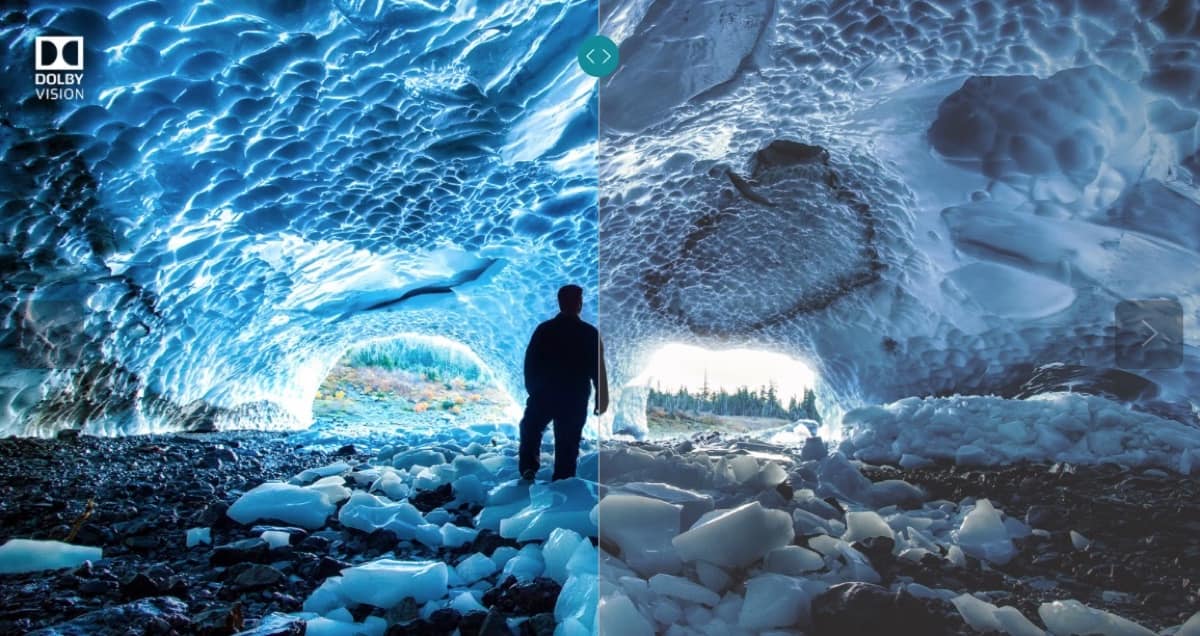
HDR (left) makes a huge difference when done correctly. Image credit: Dolby.
Throw in HDR
What if the movie is not only upscaled in the re-mastering process, but HDR metadata is thrown in? That’s perhaps something more serious to crow about. Does that now merit an increase in price over 2K Standard Dynamic Range (SDR movies)? That’s something to watch for going forward.
Bottom Line: Buyer Beware
- The bottom line is that whether 2K content is scaled by your TV up to 4K or whether the studio does it for you (and markets the video as 4K), experts say you likely won’t be able to tell the difference.
- All modern 4K TVs have a decent scaler. They have to. The Apple TV 4K has its own scaler for HD or less content. If the Apple TV 4K upscales content, your TV’s scaler will just shrug and pass the signal on without doing anything.
- Some advanced AV receivers also have a built-in scaler. I’m told it’s likely not any better than what’s in a very good 4K TV. So its use, and extra cost, is debatable.
- If the re-mastered 2K movie includes HDR, this is probably something worth looking for. What the premium should be, if at all, is an ongoing discussion.
- My guess is that the studios will continue to do this upscaling now, to ignite 4K interest and be able to claim a rich and growing catalog of 4K content. Whether there will ever be a standardized labeling process that declares the movie “shot in 4K” (or some other resolution) will likely be a long ways off, if ever. That’s up to the industry to decide.
Questions? I’ll try to answer in the comments section below.
0 Response to "What You Need to Know About 2K Movies on iTunes Upscaled and Labelled as 4K"
Post a Comment