Should Our AI Agents Be Always With Us? Or Sit On a Table? Siri?
Our artificial intelligence agents can either be embedded in our computers and/or mobile devices. Or they can reside in a cute little cyhlinder that sits on a table. Which is better? Which is the future? Which should you invest in? Maybe Siri knows.
_______________________
Apple’s CEO Tim Cook has said that our AI’s should always be with us. During Apple’s 2016 Q4 Earnings Call, he said:
I think that most people would like an assistant with them all the time. I think the advantage of one on the phone will likely be much greater… we’ve shipped more assistant-enabled devices than probably anyone out there.
And it’s true. In the 2016 holiday quarter, Apple shipped 78 million iPhones, 13 million iPads, and 5.4 million Macs. All of them have Siri. This doesn’t even include Apple Watches. The research firm Canalys estimates Apple sold 6 million of those last quarter. All in all, that’s over 100 million Siri enabled devices in one quarter.
Meanwhile, how many Amazon Echos were sold? Consumer Intelligence Research estimates Amazon sold 5.2 million for all of 2016. Ouch. (Although I did see this fantasy just as I started to publish. I don’t believe it.)

The Amazon Echo Dot is the Echo’s little brother.
Why The Big Fuss?
So why has the Echo made such a big splash? First, Amazon doesn’t make its own computers as Apple does. So Amazon, if it’s going to make its first break into the AI market, has to build those cute little stand-alone cylinders that sit on a table. And to sell a lot of them, the company’s ads have to be spectacularly good at explaining the benefits. By example. Apple, in contrast, isn’t doing much of that.
Amazon has indeed done a good job of explaining and celebrating the Echo in its TV ads. Plus, the Echo and Echo Dot are good looking pieces of hardware bringing forth a tangible physical manifestation. However, the downside of these cute little cylinders is that when you leave the room, you’re out of contact. One solution is to buy a lot of them and spread them around the house. Unsavory. Or one can use some ingenious technology, like the Ninety7Life Vaux, a battery powered speaker system that cradles the Dot and allows you to move the pair from room to room.
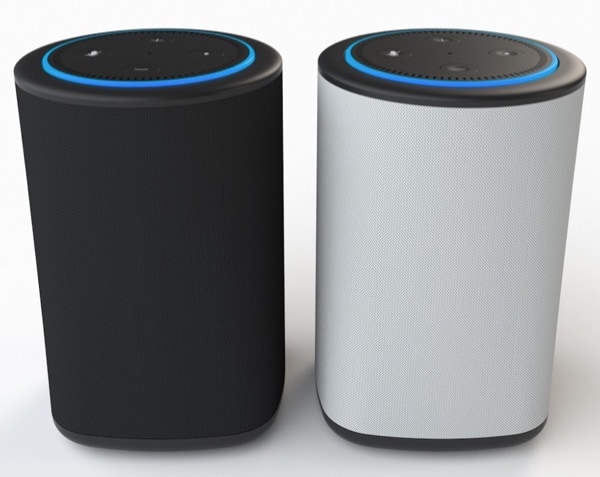
The Ninety7Life Vaux battery powered speaker also powers the Wi-FI Dot.
But that seems so awkward. Will the users really remember to grab the Vaux and Dot pair every time they leave the room? Meanwhile, if your iPhone isn’t in your pocket, your Apple Watch certainly is on your wrist. Everywhere. Even the bathroom.
Pros and Cons
Recently, I spoke with Microsoft about this. Microsoft’s Ben Rudolph explained that Cortana is always with him, either in his office or in the Surface that he carries with him. Within the constraints of privacy, Cortana (and Siri) are embedded in your computing environment—which for many people is in their face all day long.
The way Echo (and Google Home) work is to operate remotely and provide services (or Echo “skills”) via IoT, and that’s noted for not being particularly secure.
And so, while the Amazon Echo and Echo Dot get a lot of attention, it’s primarily because they have the virtue of having a “face,” not being tied to a computer and exemplified by simple understandable features that are easily advertised. But, after all, they come from a company that doesn’t have Apple’s and Microsoft’s OS and computer expertise. The choice is made for Amazon.
In the long run, I think there will be a small and stable market for these table-top AIs, but I like the way Apple and Microsoft think about the problem. With many hundreds of millions of Windows and iOS devices out there, the modern AI agent is going to manifest itself best in our mobile life. The numbers already prove it.
Of course, when our family robots in 2022 start to follow us around, like puppies, all that could change.
Next page: The news debris for the week of March 6th. The future of the Mac.
Page 2 – News Debris for the Week of March 6th
The Future of the Mac
In last week’s Particle Debris, I referred to Dan Dilger’s future of Steve Jobs’ iPad vision. This week, Author Dilger followed that up with “The future of Apple’s Macintosh.” Notable:
There are some potential ways Apple could rethink its Mac Pro strategy. The simplest change would be to open up its existing design to accommodate third party CPU and GPU processor upgrades. One path to doing this is enabled by Thunderbolt 3, which Apple demonstrated an early affinity for last fall in its design of new MacBook Pros.
By enabling third party PCIe enclosures connected with Thunderbolt 3, Apple could address the needs of high-end users of both MacBook Pros and desktop Mac Pro models. The reason why this hasn’t happened yet is obvious: Thunderbolt 3 wasn’t previously available. Simply updating the existing Mac Pro with Thunderbolt 3 would offer networked benefits for all Pro Mac users, desktop or mobile.
And then Dan Moren at Macworld ponders the situation in light of recent comments from Tim Cook: “Why the new Mac Pro might never come.”
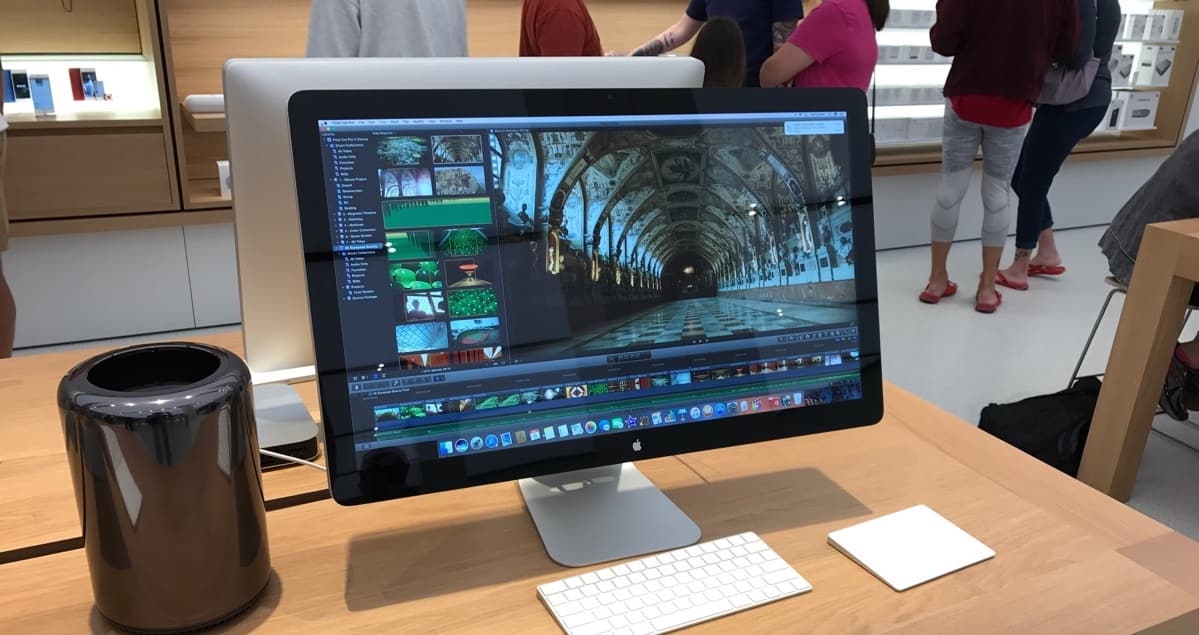
Would pro customers settle for a 2017 model simply upgraded with Thunderbolt 3 and new CPU/GPU?
Whether Apple intends to drop the Mac Pro, simply redesign it in a simple way, with more modern technology, or completely rethink the desktop Mac concept will be an interesting process to watch. Meanwhile, HP isn’t sitting around waiting for Apple to make a decision. “HP Caters to Creative/Tech Pros with Z2 Mini PC.” Neither is Microsoft.
More Debris
If you’re fantasizing about a 4K/UHD TV and don’t want to wait for the autumn sales, you may be asking yourself: what are the very best 4K/UHD TVs one can buy right now? Today. Here’s the verdict from Digital Trends. “The Best TV You Can Buy.” Perhaps Apple will announce its 4K/UHD/HDR Apple TV soon to drive one of these beauties. We can only hope.
The standard science fiction scenario is that AI’s will get out of control and destroy us all. Elon Musk worries about it. Steven Hawking worries about it. So does Bill Gates. How realistic is that fear? Scientific American’s Michael Shermer weighs in. “Artificial Intelligence Is Not a Threat—Yet.” Got that, Siri?
Will super advanced AI agents really be the end of humankind?
Modern supercomputers now have speeds in many tens of petaflops. But storage for our (super)computers always seems too slow, constrained and expensive. Hard disks use about 100,000 atoms to store one bit of data. But what if we could reduce that? IBM has figured out how to use one atom to store one bit. Wow. Think about how Watson might use 100,000 times its current storage.
When Amazon announced a real brick-and-mortar bookstore in Seattle in 2015, we weren’t sure what to make of the company’s intentions. Now, it looks like things are working out nicely. “Amazon just confirmed its 10th book store, signaling this is way more than an experiment.”
Being in the car business isn’t like dustin’ crops, kid. In hindsight, here are two articles that suggest a company like Apple never could have realistically developed the institutional and industrial capacity to be in the car business.
- Ford, not Apple, has a better chance with autonomous cars
- Tesla Doesn’t Even Have a Model 3 Beta Prototype Yet
If Tesla, with all its experience, can get into a bind like that, how could Apple have outdone Tesla? I have to ask. What were we thinking in 2016? What was Apple?
Finally, what would you like to see in iOS 11? Here’s an amazing concept video that has just about everything we’ve been asking for. Check it out and drool. Hey Apple! The gauntlet has been thrown down.
______________________
Particle Debris is a generally a mix of John Martellaro’s observations and opinions about a standout event or article of the week (preamble on page one) followed on page two by a discussion of articles that didn’t make the TMO headlines, the technical news debris. The column is published most every Friday except for holidays.
0 Response to "Should Our AI Agents Be Always With Us? Or Sit On a Table? Siri?"
Post a Comment