The Thinking Behind a Female Voice for Siri
Siri started out with a female voice exclusively, but now it can be changed to male. Alexa uses only a female voice. Cortana’s voice, for now, is strictly female. Why is that? Is it sexism? Is it for better intelligibility? Is there a compelling psychology behind the female voice for all users? I looked into it.

Siri started out with a female voice only. The competition is still there.
I got very curious about this choice of AI gender when I read Joanna Stern’s article at the Wall Street Journal: “Alexa, Siri, Cortana: The Problem With All-Female Digital Assistants.”
My first blush reaction was that it’s an intelligibility issue. I recalled previous studies, when I was younger, abut cockpit warning systems in military and commercial aircraft. The earliest, apocryphal reports were that pilots were able to better hear, against background noise, warnings in a female voice due to the frequency range. This also applies, I have heard, to radio dispatchers for the police. You can read more about the evolution of thinking and the current usage in the “Bitching Betty” article at Wikipedia. Notable, however, is this:
Arrabito in 2009, however, at Defence Research and Development Canada in Toronto, found that with simulated cockpit background radio traffic, a male voice rather than a female voice, in a monotone or urgent annunciaton style, resulted in the largest proportion of correct and fastest identification response times to verbal warnings, regardless of the gender of the listener.
I kept researching. Over the years, more complete studies have shown that the female voice isn’t necessarily easier to understand. A good summary of the technical sitation is provided by Sarah Zhang at Gizmodo. “No, Women’s Voices Are Not Easier to Understand Than Men’s Voices.” Of note:
More recently, though, a 1998 study at the Wright-Patterson Air Force Base in Ohio found the opposite: It’s actually female voices that are less intelligible against the noise inside cockpits, though the difference was tiny and only statistically significant at the highest levels of noise.
So What’s the Reason?
So, if it isn’t an intelligibility issue, why have Amazon, Apple and Microsoft made the choice for a female voice? Back to author Stern’s article.
First, the question is asked, Why Do Robots Need a Gender?” It turns out that genderless voice is very hard to achieve. So then, author Stern asks, “Why Female Then?” It turns out that market research, by Amazon and Microsoft, showed that both men and women had a stronger preference for a AI using a female voice.
The above notwithstanding, the author argues that we, as users, should have more control over the sex of the AI voice, as Apple has provided. Not doing so, despite market analysis, just perpetuates stereotypes.
My own thinking here is that AIs, as they become more and more powerful and persuasive, will take on an air of authority that will be hard to resist and could lead consumers into unintended actions. Or actions that favor the vendor over the customer. Wrapped in the aura of the male voice, there could be equally damaging social consequences, such as mass, hysterical rejection of technology.
For now, I think the instincts of the above companies are generally good. If nothing else, social pressure on the developers of these AI agnets will force them to maintain the supportive and warmer voice of the female in preference to the commanding voice of a male for potentially self-serving purposes.
This is a difficult subject. But at least we know that neither intelligibility concerns nor blatant geek, corporate sexism is driving the decision making. In the end, however, author Stern is right. Forget market research that leads to stereotyping. Like Apple, give us a choice.
Choice is good.
Next page: The news debris for the week of February 20th. One Amazon to crush them all.
Page 2 – News Debris for the Week of February 20th
One Amazon to Crush Them All
Short version. Apple’s former VP of retail sales, Ron Johnson, left Apple in 2011 to become the CEO of J.C. Penney. It was tough sledding. Mr. Johnson tried to implement some of the retailing ideas that were so successful at Apple. However, the pushback from other executives and shareholders stopped him cold when revenues declined, and he eventually left. Back in 2016, Mr. Johnson explained why Penney should have weathered the storm with him and prepared for the future. “Ex-CEO Ron Johnson Says J.C. Penney Should Have Stuck With His Plan.”
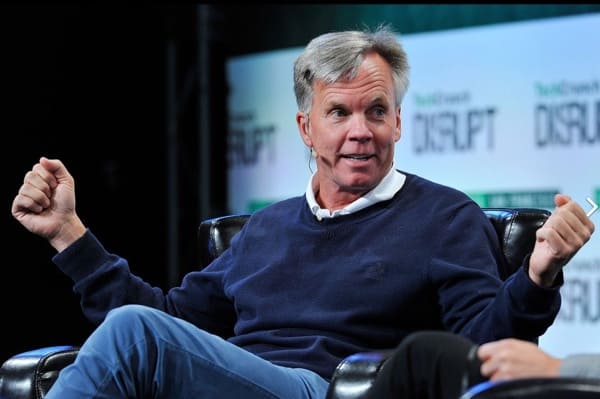
Ron Johnson (Image credit: Wikipedia)
This week, we learned that J.C. Penney’s corporate wisdom about the retail business has not fared well. “J.C. Penney to close up to 140 stores, offer buyouts.” Notable, “The company said Friday that it would shutter 13% to 14% of its locations and introduce new goods and services aimed at the shifting preferences of its customer base.” Here’s the fun part.
‘It became apparent to us that our footprint was too large,’ Penney CEO Marvin Ellison told investors Friday, and the closures will ‘allow us to raise the overall brand standard of J.C. Penney’ and invest in remaining stores.
That sounds to me like a company that’s rearranging the deck chairs and has no idea how to compete with WalMart online and Amazon. My guess and opinion is that J.C. Penney, seeing the handwriting on the wall years go, just couldn’t change. It clung to the past and didn’t trust Ron Johnson’s instincts. CEO Johnson’s notions led to financial difficulties in the early stages but likely would have turned things around down the road.
Instead, I surmise, J.C. Penney will now go the way of Borders because it takes an enormous amount of cash investment to build a major online sales presence. It’s always easier to take the money at hand, roll it up the chain of command, than spend Big Bucks on a future bet. We shall see.

Apple’s legendary “1984” TV ad. (See next.)
More Debris
Jan Dawson, who’s been on Background Mode, has written a persuasive and powerful indictment of the political aspirations of Facebook. See: “Fighting Facebook’s Power with More Facebook.”
Author Dawson starts off with:
There has been rising concern about Facebook’s power over many facets of our lives for years now and the concern is especially strong when it comes to news and media consumption where Facebook is becoming an ever more important channel. Because Facebook’s algorithms determine which things users could be shown they actually see, Facebook bears a primary responsibility for making decisions about the media world its users live in.
But then we get to a much bigger issue. Author Dawson quotes Mark Zuckerberg’s solution which is basically to turn Facebook into our virtual town hall that dictates the future course of discussion and the democratic process.
… establishing a new process for citizens worldwide to participate in collective decision-making. Our world is more connected than ever, and we face global problems that span national boundaries. As the largest global community, Facebook can explore examples of how community governance might work at scale.
If you’re alarmed by this kind of online political group-think, raise your hand.
Moving on. One sign that Apple remains very serious about working in an open way with academia in AI research is this: “Apple’s Turi acquisition funds new $1M UW professorship in AI and machine learning.”
A new $1 million endowed professorship, made possible by Apple’s acquisition of Seattle-based machine learning startup Turi last year, will give the University of Washington Computer Science & Engineering department a chance to attract more top talent in the field of machine learning and artificial intelligence.
w00t!

Jonny Evans has done a very thorough job of documenting the real prospects of Apple Pay worldwide. My guess is that more and more companies are coming to recognize how easy it is to enhance their payment security strategy with Apple Pay, but that’s just a piece of this excellent overview by author Evans. “Apple Pay Will Be Available Everywhere, Anywhere, by 2020.”
One of the questions we keep asking is what wil be the impact of computerization, AIs and robots on society? Consider this: “A conversation about the end of work, individualism, and the human species with the historian Yuval Harari” in “The Post-Human World.” It’s a sobering interview.
Finally, time for some upbeat tech. Well, maybe. Fed up with iTunes? Jeff Byrnes explains: “You Can Ditch iTunes With These Apps.”
Choice is good.
______________________
Particle Debris is a generally a mix of John Martellaro’s observations and opinions about a standout event or article of the week (preamble on page one) followed on page two by a discussion of articles that didn’t make the TMO headlines, the technical news debris. The column is published most every Friday except for holidays.
0 Response to "The Thinking Behind a Female Voice for Siri"
Post a Comment